Event planning has gone almost entirely digital. With powerful tools for online invitations, event websites, and RSVP tracking, hosts can organize everything from birthday parties to weddings without a single paper envelope. As free and low-cost platforms have multiplied, Evite remains one of the most recognized names in digital invitations. But it is far from the only option. A growing list of Evite alternatives and Evite competitors now offer deeper customization, stronger privacy, and more complete event management features for hosts who need more than the basics.
This guide covers what Evite does well, where it falls short, and the best alternatives available today, so every event planner can find the right fit.
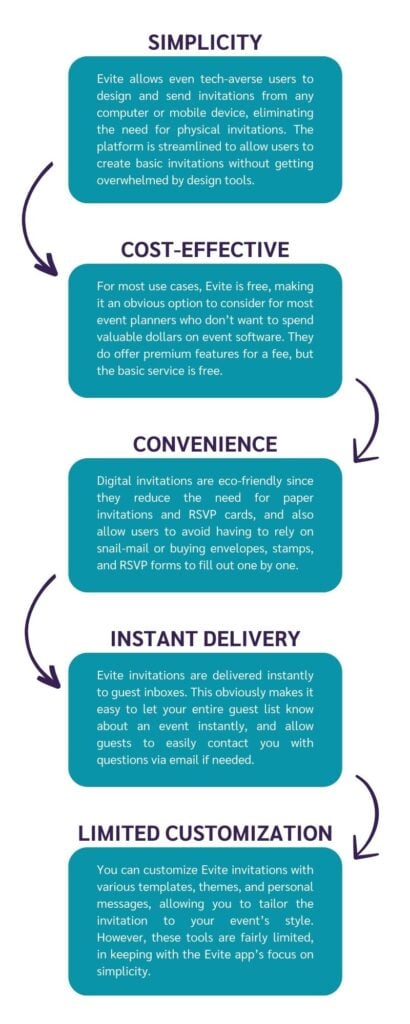
Evite has built its following by being one of the simplest platforms for casual event planning. It offers a low barrier to entry, making it especially appealing to hosts organizing a birthday party, potluck, or informal get-together on a tight budget.
Some of its most notable benefits include:
For event planners working with a non-existent budget and hosting a casual gathering, Evite does offer a fast, familiar starting point.
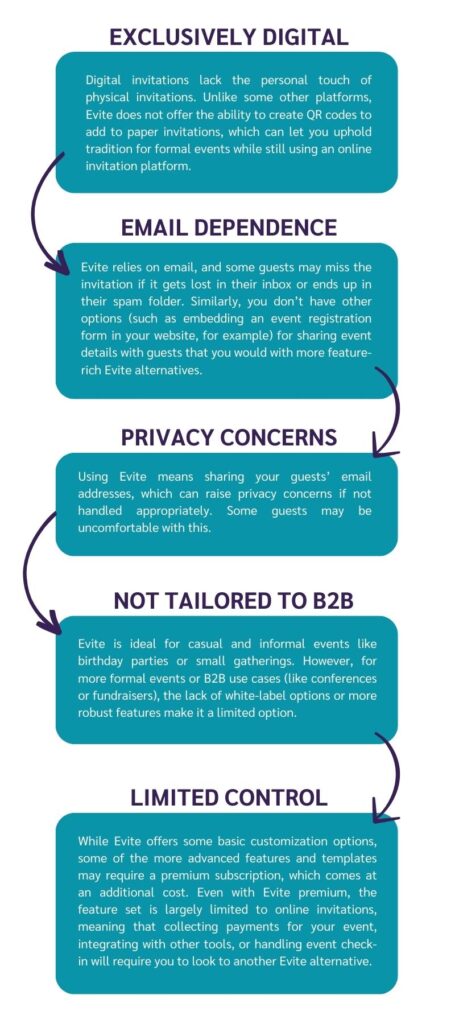
While Evite works well for simple, casual events, hosts looking for a more polished or customizable experience often run into some significant limitations.
Ads displayed to guests. One of the most common complaints about the free version of Evite is that guests see third-party advertisements alongside the invitation. For a birthday party that may be acceptable, but for a wedding, anniversary, or professional gathering, ads can undermine the tone of the event.
Limited design customization. Evite offers templates, but hosts have relatively little control over layout, fonts, colors, and branding. Anyone wanting an invitation that matches a specific theme or personal style may find the options restrictive.
No event website builder. Evite focuses on invitations and basic RSVP collection. It does not offer a dedicated event website where hosts can share schedules, directions, accommodation details, or other information that guests often need for larger or multi-day events.
Limited guest list management for complex events. For events with multiple meal choices, session selections, plus-ones, or tiered guest lists, Evite's guest management tools can feel basic. Hosts managing a wedding with 200 guests and seating assignments will quickly outgrow the platform.
No check-in tools. Evite does not include day-of event tools like guest check-in, QR code scanning, or real-time attendance monitoring. Hosts who need to track arrivals at the door must rely on separate solutions.
Privacy concerns. Evite collects guest data and serves targeted ads. Hosts who prioritize guest privacy, or who need to comply with organizational data policies, may find this approach uncomfortable.
For anyone planning a formal event, a large gathering, or an occasion where presentation and privacy matter, these drawbacks often push hosts toward more capable online invitation platforms.
If Evite's limitations make it a poor fit, the good news is that a wide range of alternatives exist, each with different strengths. Here are the best Evite alternatives to consider, organized by what each platform does best.
Canva is a versatile graphic design tool that allows hosts to create fully custom digital invitations from scratch or from thousands of templates. Its design flexibility is its greatest strength: hosts can control every element of color, typography, imagery, and layout.
Best for: Hosts who want complete creative control over invitation design and already have a separate tool for RSVP tracking.
Key limitation: Canva is a design tool, not an event management platform. It does not include RSVP tracking, guest list management, or any event logistics features. Hosts who want beautiful Canva designs paired with event management tools can pair a Canva invite with RSVPify's tools to get the best of both worlds.
Paperless Post offers elegant, highly polished digital invitations and cards designed for occasions where presentation matters. Its template library leans toward upscale aesthetics, making it popular for weddings, formal dinners, and milestone celebrations.
Best for: Hosts planning weddings, showers, or formal events who want premium invitation designs and basic RSVP collection.
Key limitation: Paperless Post's premium templates require purchasing "coins," and costs can add up quickly for larger guest lists. Its event management features beyond invitations and RSVP tracking remain limited compared to full-service platforms.
Partiful has gained popularity as a social, mobile-first invitation platform built for casual get-togethers. Its strength is speed and simplicity: hosts can create and share an event page in under a minute, and the platform integrates easily with group chats and social media.
Best for: Casual social events like house parties, happy hours, and friend group outings where a quick, informal invitation is all that is needed.
Key limitation: Partiful is designed for small, casual gatherings. It lacks the customization depth, ticketing, guest list management, and event website tools that larger or more formal events require.
Punchbowl specializes in premium digital card designs for family-oriented celebrations. Its card library is extensive, with options for birthdays, holidays, baby showers, and thank-you notes, and includes matching envelope and stamp designs for a more polished feel.
Best for: Family celebrations like kids' birthday parties, holiday gatherings, and baby showers where a charming card design sets the right tone.
Key limitation: Punchbowl's event management features are minimal. Beyond invitations and basic RSVP tracking, hosts will not find tools for ticketing, detailed guest list management, or event websites.
Greenvelope markets itself as the eco-friendly alternative to traditional paper invitations. Its digital designs emphasize sustainability, and the platform is especially popular in the wedding market for save-the-dates, invitations, and RSVP collection.
Best for: Eco-conscious hosts planning weddings or formal events who want stylish, paper-free invitations with a sustainability angle.
Key limitation: Greenvelope's pricing can be higher than other digital invitation platforms, and its feature set beyond invitations (ticketing, check-in, event websites) is limited.
Luma has become a popular choice for community organizers, professional meetups, and recurring events. It offers clean event pages, calendar integrations, and tools for building an audience over time through event series.
Best for: Community events, professional workshops, and recurring meetups where audience building and event series management matter.
Key limitation: Luma is oriented toward community and professional events. Hosts planning personal celebrations like weddings or family reunions may find its feature set and design options less tailored to those occasions.
Apple Invites is Apple's entry into digital event invitations, designed to work seamlessly within the Apple ecosystem. It integrates with iCloud, Apple Calendar, and Apple Maps, making it convenient for hosts and guests who already use Apple devices.
Best for: Apple ecosystem users planning small, personal events where tight integration with iCloud and Apple Calendar adds convenience.
Key limitation: Apple Invites requires Apple devices and iCloud accounts, which limits accessibility for guests on Android or other platforms. Its customization and event management features are basic compared to dedicated event platforms.
Eventbrite is one of the largest event management platforms, known primarily for ticketed public events like concerts, festivals, conferences, and workshops. It offers robust ticketing, attendee management, and event discovery features.
Best for: Large-scale public or ticketed events where event discovery, ticket sales, and attendee volume management are priorities.
Key limitation: Eventbrite recently eliminated almost all free plan options, making it a more expensive choice. Its interface is built for public, ticketed events and can feel heavy for private celebrations or smaller gatherings.
SignUpGenius takes a different approach, focusing on volunteer coordination, appointment scheduling, and sign-up management rather than traditional invitations. It is widely used by schools, churches, nonprofits, and businesses to organize group activities.
Best for: Organizational events, volunteer coordination, and scheduling-heavy activities where sign-up management is more important than invitation design.
Key limitation: SignUpGenius is not built for social or celebratory events. Its design options are functional rather than elegant, and it lacks the invitation, ticketing, and event website tools that personal event planners typically need.
RSVPify offers one of the most comprehensive feature sets among Evite alternatives, combining online invitations, RSVP tracking, event registration, ticketing, event websites, guest check-in, and detailed guest list management in a single platform. It is trusted by over one million event creators and thousands of organizations.
Best for: Any event type, from casual birthday parties to large-scale galas, weddings, corporate conferences, and multi-day events, where hosts need both polished invitations and full event management tools.
Key strengths:
For hosts who have outgrown Evite's basic features and want a single platform that scales from a 20-person dinner party to a 5,000-attendee conference, RSVPify is built to handle it all.
With so many options available, the right choice depends on the type of event, the features that matter most, and budget. Here is a quick comparison of the top Evite alternatives:
| Platform | Best For | Free Plan | RSVP Tracking | Custom Design | Event Website |
|---|---|---|---|---|---|
| Canva | DIY invitation design | Yes | No | Yes | No |
| Paperless Post | Formal, polished invitations | Limited | Yes | Limited | No |
| Partiful | Casual social events | Yes | Yes | Limited | No |
| Punchbowl | Family celebrations | Limited | Yes | Limited | No |
| Greenvelope | Eco-friendly weddings | No | Yes | Yes | No |
| Luma | Community and professional events | Yes | Yes | Limited | Yes |
| Apple Invites | Apple ecosystem users | Yes | Yes | Limited | No |
| Eventbrite | Large ticketed events | No | Yes | Limited | Yes |
| SignUpGenius | Volunteer coordination | Yes | No | Limited | No |
| RSVPify | All event types | Yes | Yes | Yes | Yes |
For an informal house party or friend group outing, Partiful or Evite itself may be enough. Both prioritize speed and simplicity over depth of features.
Hosts planning a wedding, anniversary, or milestone celebration should look at Paperless Post for premium invitation designs, Greenvelope for an eco-friendly option, or RSVPify for a platform that handles invitations, RSVP management, guest lists, seating, and event websites in one place.
Business events, professional meetups, and workshops benefit from platforms with registration forms, branding options, and attendee management. Luma works well for recurring community events, while RSVPify offers the event registration and branding depth that corporate events demand.
For festivals, conferences, and public events with ticket sales, Eventbrite remains a strong option despite its pricing changes. RSVPify also supports ticket sales and payment processing with more flexible pricing and stronger branding control.
Several Evite alternatives offer free plans, including Partiful, Canva, and RSVPify. Among these, RSVPify's free tier stands out because it includes not just invitations but also RSVP tracking, guest list management, and event website tools at no cost, giving hosts a more complete set of features than most free alternatives.
Evite still has a large user base and remains a familiar name in digital invitations. However, many hosts have moved to alternatives that offer fewer ads, more customization, stronger privacy, and broader event management features. Evite works well for simple, casual events, but hosts with more complex needs often find that newer platforms have surpassed it.
It depends on the event. Punchbowl offers more polished card designs and a more premium feel for family-oriented celebrations, while Evite provides a broader range of free templates for casual events. Neither platform offers deep event management features like ticketing, custom registration forms, or event websites. Hosts who need those capabilities may find that a more comprehensive platform like RSVPify is a better fit than either option.
Evite and Partiful both excel at casual event invitations, but they take different approaches. Evite offers a wider template library and has been around longer, while Partiful is more mobile-native and social, designed for quick sharing through group chats. For hosts who need features beyond basic invitations (ticketing, event websites, detailed guest management), a platform like RSVPify offers more room to grow.
Evite is primarily designed for personal, social events. Its ad-supported model, limited branding options, and basic feature set make it a poor fit for most business or professional events. Hosts organizing corporate gatherings, conferences, or professional networking events typically need platforms with custom branding, registration forms, attendee data management, and payment processing, features that platforms like RSVPify and Eventbrite provide.
Evite's free plan is available regardless of guest list size, but the free tier displays ads to guests and offers limited design customization. For larger events where presentation, guest experience, and privacy matter, hosts often find that the trade-offs of a free, ad-supported platform are not worth the savings. Many alternatives, including RSVPify, offer free plans without guest-facing ads.
About the Author
Get the latest product updates, event planning tips, and industry insights — straight to your inbox.
You can unsubscribe at any time. Your email will only be used to send RSVPify updates and will never be shared.